
10
Few design elements possess the transformative power of an area rug. It can pull a scattered collection of furniture into a cohesive conversation zone, soften room acoustics, introduce rich tactile contrast, and visually expand tight quarters. Yet, despite its importance, the area rug is also one of the most frequently mishandled investments in interior decorating.
Walk into almost any home that feels slightly off-kilter, and you will likely find the same culprit: a floating postage stamp. A homeowner falls in love with a striking pattern, balks at the price tag of a larger size, and brings home a five-by-seven-foot rug that sits stranded under a coffee table, touching none of the seating around it. Instead of grounding the room, an undersized rug truncates visual space, making expansive rooms feel disjointed and compact rooms feel claustrophobic.
Getting the scale and placement right does not require an interior design degree, but it does require understanding spatial proportions. When you approach rug sizing as an architectural decision rather than an afterthought, choosing the right dimensions becomes straightforward and intuitive.
The Foundation Principles: Scale, Clearance, and Proportion
Before measuring furniture or agonizing over pile heights, you must consider the boundaries of the room itself. A rug should never be treated as wall-to-wall carpeting, nor should it look like a casual throw mat dropped in the center of the floor.
The foundational guideline of rug placement is the 18-inch border rule. In traditional, generously proportioned rooms, leaving roughly eighteen inches of bare flooring exposed between the edge of the rug and the baseboards creates a balanced perimeter. This reveal frames the textile, celebrates the underlying hardwood or tile, and prevents the space from looking crowded.
In smaller urban apartments, historic homes, or compact secondary bedrooms, eighteen inches can swallow too much usable area. In these settings, scale the border down to eight to twelve inches. The objective remains the same: preserve a visible margin of flooring around the perimeter so the rug acts as a defined platform rather than an ill-fitting wall-to-wall substitute.
Another critical consideration is foot traffic. When moving through a room, a person should ideally walk either entirely on a rug or entirely off it. A layout that forces someone to walk with one foot on a thick wool pile and the other on hardwood creates a jarring physical transition and accelerates uneven edge wear on the textile. Map your primary pathways before finalizing your dimensions.
The Living Room: Choosing Between Three Classic Layouts
Living rooms are social hubs where furniture arrangements are dynamic and varied. Because seating configurations dictate rug requirements, designers rely on three distinct placement methods depending on room dimensions, furniture styles, and budget.
All Legs on the Rug
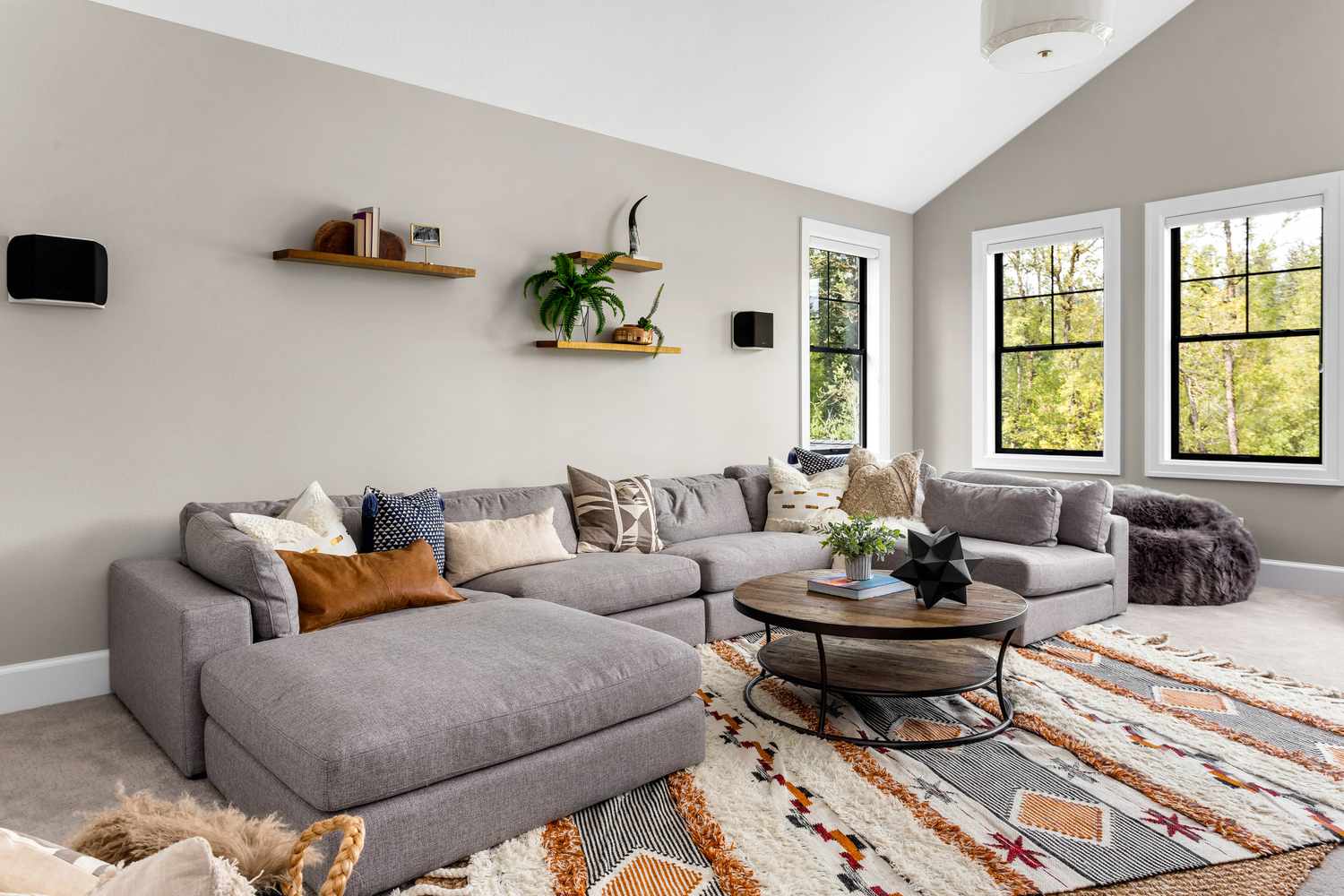
The all-legs-on approach is the gold standard for large, open-concept living spaces and floating furniture configurations. In this setup, every piece of seating—sofa, armchairs, side tables, and credenzas—rests entirely within the perimeter of the rug.
This layout creates an unmistakable sense of luxury and structural unity. By containing the entire conversation zone within a single textile boundary, it forms a dedicated room within a room. To pull this off without crowding, you generally need an expansive rug—typically nine-by-twelve feet, ten-by-fourteen feet, or larger. Ensure the rug extends at least six inches past the outer edges of the furniture so the grouping never looks pinched.
Front Legs on, Back Legs Off
By far the most versatile and budget-conscious configuration, the front-legs-only approach works beautifully in average-sized living rooms where furniture rests near or against perimeter walls.
Under this rule, the front feet of the sofa and accent chairs sit on the rug, while the rear feet remain on the bare floor. This anchors the furniture to the textile and visually knits the seating cluster together without demanding the square footage required to capture the back legs.
Proportion matters here: the rug should slide under the furniture far enough to look intentional—ideally extending at least one-third to one-half of the way under the sofa. If the front legs merely graze the outer binding by half an inch, the arrangement will look accidental. If uneven furniture height causes an annoying wobble, slip inexpensive adhesive felt pads under the rear legs to level the piece.
All Legs Off (The Floating Layout)
In this arrangement, only the coffee table rests on the rug, while all surrounding seating sits entirely outside its perimeter.
While common in starter apartments, design professionals generally advise against this approach for primary living areas. Floating a small rug in the middle of a seating cluster often exaggerates the distance between chairs, making the room feel cold and fragmented.
The rare exception occurs in extremely narrow living rooms where a larger rug would climb the baseboards, or when you are layering an organic cowhide or freeform accent rug over a neutral foundation. If you must use a smaller rug with all legs off, ensure the rug fills the space between the sofa and facing chairs comfortably, extending beyond the length of the coffee table by at least several inches on either side.
Handling Sectional Sofas
L-shaped and U-shaped sectionals demand special attention. Because of their continuous footprint, standard rectangular rules can break down.
When sizing a rug for a sectional, the rug must be large enough to host the front legs of the entire sofa, including the chaise or corner return. An undersized rug tucked into the crook of an L-shaped sofa looks visually swallowed. Measure the full length and width of the sectional footprint and choose a rug that extends at least twelve to eighteen inches beyond the open sides, giving the arrangement breathing room.
The Dining Room: The Non-Negotiable 24-Inch Rule
While living room layouts offer flexibility, the dining room is governed by a strict, functional requirement driven by human ergonomics: the chair pull-out test.
When guests sit down at a dining table, they push their chairs backward to sit, then pull them forward to eat. If your rug ends just behind the table legs, the rear chair casters or feet will catch on the rug edge every time someone stands up. This creates an irritating tripping hazard, spills drinks, and damages the rug binding.
To prevent this, the rug must extend at least twenty-four inches beyond all sides of the dining table. This clearance allows diners to slide chairs back comfortably while keeping all four chair legs squarely on the textile. If your dining chairs are deep armchairs or host chairs with wider stances, push that measurement to thirty inches.
Table shape should also dictate your rug silhouette. A rectangular dining table calls for a rectangular rug to echo its linear proportions. A round table looks most harmonious centered on a generous round or square rug. Pairing a small round rug beneath an oblong eight-person trestle table creates visual discord that disrupts the entire room.
Finally, consider the rug weave. Dining spaces call for flatweaves, tight kilims, or dense low-pile wools. Avoid plush shags or heavily textured loop piles, which make sliding dining chairs difficult and trap dropped crumbs deep within the fibers.
The Bedroom: Framing the Sleep Sanctuary
A bedroom rug serves a sensory purpose as much as a visual one: it should be the soft, warm surface your bare feet touch when you swing out of bed in the morning. Achieving that comfort while keeping the bed properly framed depends on how you orient the rug.
The Two-Thirds Placement
The most classic and aesthetically balanced bedroom configuration places the rug perpendicularly under the bottom two-thirds of the bed frame.
Under this layout, the rug stops just forward of the nightstands, sliding under the lower portion of the mattress and extending past the foot of the bed. This keeps the nightstands sitting flat on the hardwood floor—eliminating uneven tipping when placing water glasses or lamps—while providing plenty of plush coverage where you step in and out of bed.
-
For a Queen Bed: An eight-by-ten-foot rug is the ideal standard. It provides approximately two to two-and-a-half feet of exposed rug along both sides and extends past the footboard with enough depth to accommodate an end-of-bed bench. A six-by-nine-foot rug can work in tight rooms, but it will yield a much narrower border along the sides.
-
For a King Bed: Step up to a nine-by-twelve-foot rug. A King frame is wide enough that an eight-by-ten rug will feel skimpy along the sides, often leaving barely eighteen inches of exposed pile once the mattress frame is accounted for. A nine-by-twelve provides proportional balance and generous underfoot comfort.
The Runner Strategy
If your bedroom is long and narrow, or if you have built-in cabinetry that limits clearance, buying a massive nine-by-twelve rug may not be practical. A smart, budget-conscious alternative is framing the bed with two matching runners.
Place one runner along each side of the bed, positioning them so they align with the edge of the nightstand and extend to the foot of the bed frame. This targets the rug exactly where you need the sensory benefit—underfoot upon waking—without paying for square footage hidden underneath a box spring.
Hallways, Entryways, and Kitchens: Managing High-Traffic Lines
Utility areas and transitional hallways experience relentless foot traffic, making proper sizing vital for both safety and durability.
In hallways, a runner should visually lengthen the corridor without filling it entirely. Aim to leave three to five inches of bare floor visible on both sides of the runner. If a runner is too wide, it buckles against the baseboards; if it is too narrow, it looks like a tightrope. Avoid running a textile all the way to the door casing; leave at least twelve to eighteen inches of open floor at each end of the hall to mark clean transitions between spaces.
In entryways and foyers, measure door swings before falling in love with a rug. A thick wool hand-tufted rug placed in front of an exterior door can jam the weatherstripping every time the door opens. Opt for low-clearance, tightly woven textiles or recessed walk-off mats that allow the door to swing freely while still establishing a welcoming drop zone.
For kitchens, long runner rugs placed parallel to the primary counter run or nestled between an island and the sink line provide comfort during meal prep. Ensure the runner spans the major active work triangle rather than leaving awkward foot-wide gaps between the cooktop and sink.
Fine-Tuning Your Placement: Pro Tips Before You Buy
Even with exact dimensions in hand, spatial perception can be deceptive. A few practical preparation steps will ensure your chosen size translates seamlessly from paper to your floor.
Map the Perimeter with Painter’s Tape
Before entering payment details online or walking into a showroom, take a roll of blue painter’s tape and map out the exact dimensions of the rug on your bare floor.
Walk through the room with the tape on the ground. Open interior doors to check clearance. Pull back the dining chairs to see where the legs land. Sit on the sofa and verify that your feet rest comfortably within the taped perimeter. This ten-minute exercise reveals scale issues that no digital floor planner can simulate, saving you the logistical headache of returning a heavy, hundred-pound rolled carpet.
The Power of Layering
If you own an antique tribal rug, a vintage silk piece, or an irregular animal hide that is simply too small for your room, do not force it into a floating layout. Use the designer technique of layering.
Purchase an inexpensive, oversized foundation rug made from textured natural fibers—such as bleached jute, sisal, or flat-woven wool—sized to anchor the entire room properly using the all-legs or front-legs rule. Then, center your smaller, high-character accent rug diagonally or squarely on top. The natural fiber rug handles the structural scale of the space, while the top rug provides pattern, color, and personal narrative.
Never Skip the Rug Pad
A rug pad is not an optional accessory; it is an essential structural component of the installation. Without a pad, even an expensive, perfectly sized rug will shift, ripple, bunch up under furniture, and slip across slick hardwoods.
Choose a dual-sided felt-and-rubber pad trimmed approximately one inch smaller than the rug perimeter on all sides. The dense felt adds luxurious cushioning underfoot, prevents furniture divots from cutting through the foundation yarns, and allows the rug to breathe, while the natural rubber backing grips the floor without discoloring wood sealants.
By treating the area rug as a foundational architectural anchor rather than a simple decorative layer, you establish balance and purpose across your entire living space. Take the time to measure your furniture, honor clear floor margins, and commit to the right scale. The result is a room that feels intentional, grounded, and welcoming from the moment you step inside.
