
7
Discovering a sudden cloud of winged insects hovering around your living room window or crawling across a basement baseboard is enough to make any homeowner pause. Your mind immediately jumps to the worst-case scenario: an active termite infestation silently eating away at your wall studs, floor joists, and subflooring. Yet, just as often, those mysterious intruders turn out to be flying ants—nuisances in their own right, but representing a completely different biological profile and threat level.
Both insects produce winged reproductives that take flight to mate and establish new colonies. To the untrained eye, a swarm of dark, fluttering bodies looks virtually identical whether they are subterranean termites or carpenter ants. Knowing how to distinguish between the two is critical. A misidentification can lead to thousands of dollars in unnecessary treatments for harmless ants, or worse, months of untreated wood destruction while termites hollow out structural timber.
By focusing on three specific anatomical features, observing behavioral clues, and looking for telltale secondary signs, you can determine exactly what you are dealing with and take the right action.
The Three-Second Anatomy Check
When you spot winged insects, catching a single specimen in a clear jar or trapping it under a piece of transparent tape gives you all the evidence you need. While their silhouettes appear interchangeable from several feet away, their physical anatomy reveals striking differences under closer inspection.
Waistline: Pinched vs. Broad
The most reliable differentiator between an ant and a termite is the shape of the waist.
Ants possess a distinct, constricted waist known as a petiole. This narrow stalk separates their thorax from their abdomen, giving them a segmented, hourglass figure similar to a wasp or bee. You can clearly see three distinct body sections: head, thorax, and abdomen.
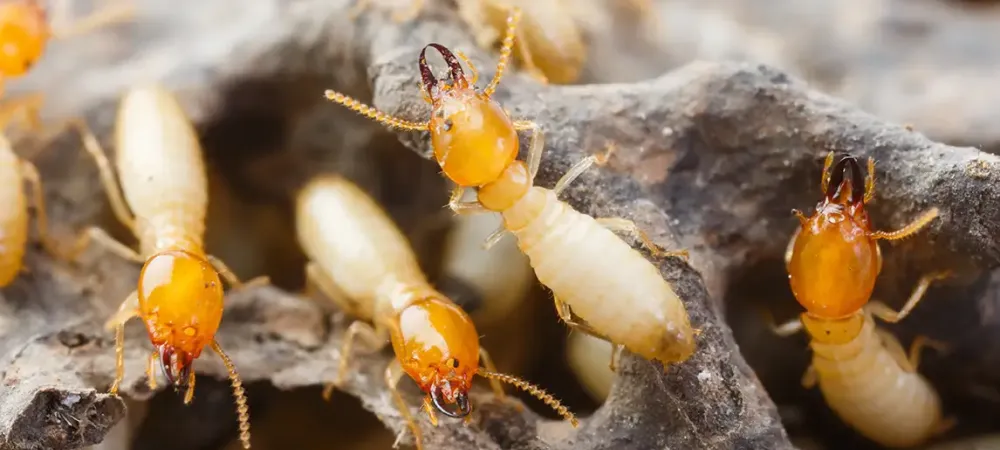
Termites, by contrast, have a broad, uniform waist. Their thorax connects smoothly to their abdomen without any indentation or tapering. A termite’s body appears tubular, cigar-shaped, or oblong, maintaining a consistent width from just behind the head all the way to the tip of the abdomen.
Wings: Mismatched Pairs vs. Equal Lengths
Both winged ants and winged termites belong to orders that produce two pairs of wings—four wings total. However, the architecture and proportion of those wings are completely different.
Termite swarmers, scientifically referred to as alates, have four wings that are identical in size and shape. These wings are paddle-shaped, milky or translucent, and significantly longer than the insect’s actual body—often extending twice the length of the abdomen. Termite wings feature a delicate, reticulated pattern of fine veins that resemble cracked glass under light.
Flying ants carry two pairs of wings of unequal length. Their front wings (forewings) are noticeably larger and longer than their hind wings. Ant wings are typically clear with a few prominent, dark structural veins, and they rarely extend far beyond the tip of the insect’s rear body segment.
Antennae: Bent Angles vs. Straight Beads
If you examine the head through a magnifying glass or a smartphone camera zoomed in close, look at the antennae.
Ants feature elbowed antennae. The first segment extends outward before bending sharply at a joint, creating an unmistakable L-shape or hinge.
Termites have straight, bead-like antennae. They resemble a tiny string of pearls extending forward or slightly outward from the head without any sharp bends, knuckles, or elbows.
Decoding the Swarm: Behavior, Timing, and Shed Wings
Identifying the insect itself is only half the battle. How, when, and where the swarm appears provides valuable context about the severity of the situation.
Swarming is not an everyday occurrence; it is a synchronized biological event triggered by precise environmental cues. When a mature colony reaches peak population, it produces fertile, winged males and females. These reproductives emerge simultaneously in a nuptial flight to disperse, pair off, shed their wings, and burrow into suitable ground or wood to establish new colonies.
The Phenomenon of Discarded Wings
One of the clearest indicators of a termite presence involves what the insects leave behind after the flight ends. Termite wings are designed strictly for short, clumsy dispersal flights. Once a termite swarmer lands and finds a mate, its wings detach along a natural fracture line with minimal effort.
If you find piles of shed, identical wings accumulated along windowsills, caught in spiderwebs, or collected in corners of your garage, you are almost certainly dealing with termites.
Flying ants do not shed their wings casually. While mated queen ants do eventually tear off their wings before excavating a nest, male ants retain theirs until death, and worker ants never have them. You will rarely, if ever, find large drifts of detached ant wings scattered around your home.
Seasonal Timing and Weather Triggers
While seasonal overlaps occur, termites and ants follow different biological calendars.
Subterranean termites typically swarm in the early spring, frequently on the first warm, sunny morning following a heavy soaking rain. In contrast, drywood termites tend to swarm later in the year, often during late summer or early fall when temperatures peak.
Flying ants, particularly carpenter ants, usually swarm from late spring into mid-summer. Their flights often occur during late afternoons or humid evenings. While weather patterns can blur these timelines depending on your local climate, a massive swarm appearing in March or April after a spring thunderstorm points heavily toward subterranean termites.
Inside vs. Outside: Assessing the True Threat Level
Where you find the swarm dictates your immediate level of concern.
Seeing a swarm outdoors—rising from a tree stump in the backyard, drifting across a patio, or emerging from an old landscape timber—is not an automatic emergency. Subterranean termites and carpenter ants are common, beneficial components of the natural ecosystem, breaking down dead wood in forests and soil across North America. Seeing swarmers outdoors simply confirms that a mature colony lives somewhere in your neighborhood. As long as your foundation is properly sealed and protected, those outdoor insects may never interact with your home.
Finding a swarm inside your living space is a completely different story.
Neither termites nor flying ants intentionally enter a house from the outdoors to hold a nuptial flight. If you walk into a room and find dozens or hundreds of winged insects flying toward the light of a window, those insects almost certainly emerged from within your home’s framing, subfloor, or foundation walls.
For termites, an indoor swarm indicates that an established colony has already compromised structural components and matured enough to produce reproductives—a process that typically takes three to five years. For flying ants, an indoor swarm suggests a satellite nesting site established inside wall voids, roof cavities, or damp insulation.
Structural Evidence: What They Leave Behind in the Wood
Understanding what these insects do after they lose their wings helps distinguish their ongoing impact on your home. Their feeding and nesting behaviors could not be more different.
Termites are true wood-eaters. They possess specialized microorganisms in their digestive tracts that break down cellulose, allowing them to digest structural lumber, plywood, drywall paper, and even cardboard. Because subterranean termites require high humidity to survive, they construct mud tubes—pencil-thick tunnels made of soil, wood particles, and saliva—along foundation walls, concrete piers, and floor joists to travel safely between the moist ground and their feeding sites. Termites eat wood from the inside out, following the softer grain, leaving behind hollowed timber with a paper-thin outer shell that sounds dull or hollow when tapped.
Ants do not consume wood. They are omnivores that forage for proteins, sugars, and other insects. However, carpenter ants excavate wood to carve out clean, smooth nesting galleries for their brood. Rather than digesting the wood, they chew through it across the grain and kick the debris out through tiny slit openings in the surface. This discarded material, known as frass, resembles fine wood shavings or pencil sharpener residue mixed with microscopic fragments of dead ant parts. If you find small piles of sawdust beneath a wall or baseboard, you are looking at carpenter ant activity rather than subterranean termites.
Practical Next Steps for Homeowners
When faced with winged insects indoors, resist the urge to panic and spray general-purpose aerosol insecticides across the room. Surface sprays only kill the visible swarmers, leaving the parent colony completely unharmed inside the walls.
Take a measured approach to resolve the problem effectively:
-
Collect and preserve samples. Capture several insects in a sealable plastic bag or a small jar containing rubbing alcohol. Having intact specimens allows a pest control professional or your local county extension office to confirm the exact species under magnification.
-
Vacuum the swarmers. Use a standard vacuum cleaner to quickly remove live insects and loose wings from windowsills and floors, then empty the canister or bag into an outdoor trash receptacle.
-
Inspect for moisture issues. Both carpenter ants and termites thrive in moist environments. Check your basement, crawl space, attic, and plumbing fixtures for active leaks, high humidity, or chronic condensation that may have softened structural wood.
-
Schedule a professional inspection. Addressing subterranean termites requires specialized treatments, such as liquid non-repellent soil barriers or subterranean bait stations. Carpenter ants require locating the primary nest, treating satellite wall voids, and eliminating moisture sources.
Taking a few minutes to inspect the waist, wings, and antennae of the insects in front of you provides immediate clarity, allowing you to address the root of the problem before costly structural damage takes hold.
