
12
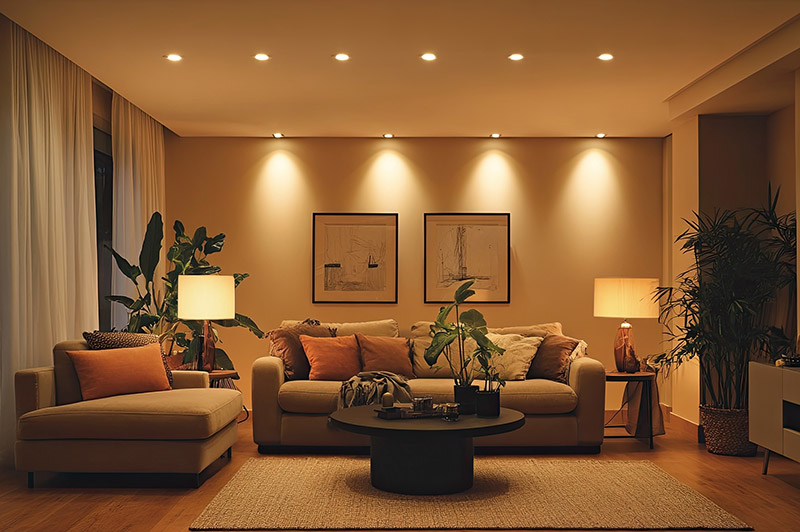
Walking into a living room or bedroom with no central ceiling fixture can feel like an architectural puzzle. Whether you are settling into a historic apartment with untouched plaster, renting a mid-century flat, or outfitting a modern home where the builder omitted overhead junction boxes, the immediate consequence is the same: once the sun sets, the room threatens to become a shadowy cavern.
The conventional response is often an impulsive trip to a big-box retailer for a single, high-intensity torchiere lamp. Pushed into a far corner and turned up all the way, that solitary fixture creates an uncomfortable glare in one spot while leaving the rest of the room murky and flat.
Designers rarely rely on central ceiling fixtures anyway. The so-called big light tends to flood an interior with harsh, downward-facing illumination that washes out texture, flattens architectural depth, and casts unflattering shadows across faces. When a space lacks overhead wiring, you are freed from relying on that single ceiling box. By building a thoughtful scheme using ambient, task, and accent fixtures across varying heights, you can craft a space that feels warmer, more functional, and far more inviting than any room lit solely from above.
Rethinking the Room: The Three Core Layers of Illumination
A well-lit room never relies on a single light source to do everything. Successful interior lighting balances three distinct layers, each handling a specific visual task.
Ambient lighting represents the foundation. It serves as the general illumination that replaces lost daylight, allowing you to walk into a room, sit down, and navigate safely without squinting. In spaces without ceiling cans or chandeliers, ambient light must be produced indirectly by bouncing light off broad reflective surfaces or through wide, translucent shades that disperse light in all directions.
Task lighting delivers targeted illumination for specific activities. Reading on the sofa, writing at a desk, playing a board game, or sewing all require concentrated light directed right at the work surface. Because task fixtures sit close to the user, they prevent you from working in your own shadow.
Accent lighting introduces visual interest, mood, and depth. It does not exist to help you read or clean; its sole purpose is to draw the eye toward decorative highlights, sculpt the perimeter of the room, and eliminate dark corners. Accent light illuminates artwork, highlights bookshelves, or grazes an exposed brick wall.
When you balance these three layers, the room ceases to feel like a box lit from the center and instead becomes an environment rich in depth, contrast, and visual comfort.
Establishing the Ambient Base Without a Center Ceiling Box
Without an overhead junction box, your primary goal is to simulate the wide, even distribution of general ambient light without introducing harsh glare. The most effective approach is to harness your walls and ceiling as giant, passive reflectors.
Bouncing Light Off the Ceiling Plane
Ceilings painted in white, off-white, or pale neutral tones are remarkable reflective surfaces. When upward-facing fixtures push lumens directly into the ceiling, that light scatters broadly, raining down as a soft, shadow-free glow that mimics indirect daylight.
Compact floor canister uplights tucked behind furniture offer an unobtrusive way to achieve this bounce. Placed behind an armchair, a credenza, or a substantial potted plant, a canister light throws light straight up the wall. The wall and ceiling diffuse the beam across the room, while the furniture silhouettes softly in front of it.
For open wall runs, consider modern architectural torchieres. Unlike older designs with exposed bulbs, quality contemporary torchieres feature wide diffusers or indirect LED heads designed specifically to project high-lumen illumination straight upward. Positioned along long walls, a pair of subtle torchieres can provide all the general background light a medium-sized living space requires.
The Arch Lamp as an Overhead Stand-In
If your furniture layout calls for a centered, downward pool of light over a coffee table or a sectional sofa, an arching floor lamp offers the footprint of a suspended pendant without the wiring hassle.
An arch lamp anchors its weighted marble or metal base securely against a wall or behind a couch, extending a slender arm several feet outward into the center of the living area. The shade hangs directly over your primary seating zone.
To maximize ambient value, opt for a fixture with a fabric, parchment, or woven drum shade rather than a solid metal cone. Fabric shades permit light to escape sideways through the material to warm the surrounding air, while simultaneously casting a focused pool of light onto the table below.
Plug-In Swag Pendants for Centered Illumination
When you desire a true suspended fixture directly over a dining table or conversational cluster, a plug-in swag pendant provides a straightforward solution.
A swag pendant features an overhead shade wired to a generous length of decorative, fabric-sheathed cord terminated with a standard wall plug. By mounting two heavy-duty ceiling hooks—one centered over your target furniture and another near the wall junction—you can suspend the fixture at the exact height required and dress the cord down toward the baseboard.
To keep the installation clean and intentional, select fixtures that celebrate the hardware. Brass swag hooks, substantial woven textile cords, and matching cord anchors turn what could be a makeshift solution into a deliberate design choice.
Anchoring the Middle Ground: Intentional Task Lighting
With your general background illumination set, you must bring light down to the human level. Task lighting populates the mid-tier zone, roughly two to five feet off the floor, right where you interact with your furniture.
Flanking Seating Areas with Table Lamps
Table lamps remain the workhorses of mid-level lighting. However, placing a single table lamp at the end of a sofa creates an asymmetric, unbalanced room where one side feels cozy and the opposite feels neglected.
Aim to introduce pairs or balanced groupings of lamps across the primary seating layout. A matched pair of table lamps flanking an upholstered sofa grounds the seating arrangement and frames the room. For comfortable reading, the lower edge of the lampshade should align roughly with your eye level when seated—typically between thirty-eight and forty-two inches from the floor. This positioning ensures that the direct glare from the bulb is shielded by the shade while the pool of downward light lands cleanly across your lap or side table.
Articulated and Swing-Arm Wall Sconces
When floor space is scarce and end tables are small, walls provide valuable real estate for task illumination. Plug-in wall sconces bring the polished aesthetic of hardwired lighting without requiring an electrician.
Sconces with articulating arms or pivot heads are ideal beside beds, adjacent to reading armchairs, or flanking a small workspace. You can pull the fixture forward to illuminate a book or project, then swing it flush against the wall when you finish. Many modern plug-in sconces include dedicated matching metal cord covers, which snap over the hanging electrical wire to create a clean, integrated finish that matches the baseplate.
Sculpting Depth with Accent and Low-Level Perimeter Lights
Rooms lit entirely from the middle often suffer from dark, receding edges. Because human eyes perceive the dimensions of an interior based on its furthest visible boundaries, dark corners make spaces feel restricted and cramped. Accent lighting brings those forgotten borders back to life.
Illuminating Vertical Surfaces
Lighting artwork or wall displays does double duty: it showcases your collections while reflecting ambient warmth back into the interior.
Plug-in picture lights mounted over framed prints, paintings, or gallery walls direct soft pools of light across the art surface. The canvas and glass act as gentle light bounces, pulling the eye outward toward the perimeter. Similarly, slender puck lights or magnetic wall spots mounted above wall shelving bring vertical architectural features to the forefront.
Bookcase and Cabinet Grazing
Bookshelves, display vitrines, and credenzas offer prime opportunities for discreet accent light. Installing slim LED light strips or micro-puck lights inside open shelving units transforms plain storage into a warm architectural feature.
When mounting LED channels, place them along the underside of shelf fronts facing backward, or tucked just behind the front lip facing downward. This placement conceals the individual diode dots and prevents glare, bathing the books, ceramics, and personal keepsakes in an elegant, even wash.
Grounding the Room with Low-Level Illumination
Not all light needs to live at eye level or above. Introducing gentle, low-level illumination along the bottom eighteen inches of a room grounds the space and creates a luxurious, restful ambiance after twilight.
Placing diffused LED tape along the back edge of a floating media console or beneath a low bed frame creates an understated floating effect. The soft glow washes across baseboards and floors, providing enough light for midnight navigation while adding a layer of subtle dimension that overhead fixtures cannot replicate.
Technical Rules: Lumens, Kelvins, and Light Quality
A comprehensive lighting layout can easily be ruined by selecting the wrong light bulbs. When you rely on multiple portable fixtures, harmonizing bulb specifications ensures the room feels cohesive rather than jarring.
Color Temperature Consistency
Color temperature, measured in Kelvins, determines whether light appears warm and golden or cool and crisp. In residential spaces without overhead fixtures, maintaining consistency across every bulb in the room is critical.
-
2700K (Warm White): The universal standard for cozy residential living areas and bedrooms. It mimics the gentle, relaxing amber hue of traditional incandescent filaments, flattering skin tones and complementing warm wood finishes.
-
3000K (Soft White): A slightly crisper, cleaner warm light that works well in modern, minimalist spaces, open-concept living-dining rooms, and dedicated home office areas.
-
4000K and Above (Cool White/Daylight): Best avoided in relaxing spaces. High-Kelvin light appears clinical, blue-tinged, and cold, undermining the comfortable atmosphere you are trying to cultivate.
Mixing color temperatures within the same room produces visual discord; a 4000K bulb sitting near a 2700K fixture makes the warmer light look dingy and the cooler light look sterile. Choose one baseline—ideally 2700K for living spaces—and match it across every lamp.
Calculating Lumens for the Space
Forget evaluating brightness by wattage, which measures energy draw rather than light output. Look instead at lumens.
As a reliable baseline, a living room typically requires ten to twenty lumens per square foot of total illumination distributed across all fixtures combined. A bedroom needs slightly less, around ten to fifteen lumens per square foot.
For a two-hundred-square-foot living room, your target is between 2,000 and 4,000 total lumens. Distribute those lumens across five or six individual light points—such as two 800-lumen table lamps, an 800-lumen ceiling-bounce torchiere, a 450-lumen task reading light, and a pair of 200-lumen accent lights. By spreading out the output, no single source has to work too hard, eliminating blinding glare while achieving comfortable overall brightness.
Color Rendering Index (CRI)
Always check the Color Rendering Index rating on LED packaging. Aim for bulbs with a CRI of 90 or higher. Inexpensive, low-CRI bulbs distort color perception, making warm woods appear gray and fabric upholstery look flat. High-CRI bulbs reveal true pigments, bringing richness and vibrancy to fabrics, art, and natural materials.
Unifying the System: Controls, Cord Management, and Harmony
The most common frustration with rooms reliant on plug-in lamps is control. Walking from corner to corner each evening to manually flip six distinct switches is tedious, and it often leads people to leave half their lamps turned off.
Streamlining Controls with Smart Plugs
Smart plugs and wireless switching solve the convenience problem entirely. By plugging floor lamps, table lamps, and accent lights into smart receptacles, you can bind every light in the room into a single ecosystem.
A wireless, battery-operated smart switch can be adhered to the wall right beside the entry door, functioning exactly like a standard hardwired switch. A single tap as you step through the threshold brings the entire multi-layered lighting scheme to life instantly.
Using automation apps, you can also establish distinct scenes tailored to your routine. An “Evening Entertaining” scene might activate all ambient and accent fixtures at full brightness, while a “Late Night” scene powers down the torchieres and leaves only a dim pool of light beside the reading chair and along the credenza base.
Taming Exposed Cords
A room illuminated by multiple plug-in fixtures introduces a practical aesthetic challenge: visible power cords stretching across baseboards and flooring.
Keep your installation visually clean with deliberate cable management:
-
Paintable wire channels: Run sconce cords through rigid surface raceways mounted to the wall, then paint them with the wall color to blend them into the drywall.
-
Furniture concealment: Secure lamp cords along the rear legs of tables and credenzas using small adhesive clips or velcro ties, guiding the wire directly downward to outlet height.
-
Under-rug routing: When powering a table lamp on a floating console table away from walls, use flat, heavy-duty extension cords routed underneath area rugs, protected beneath a dense rug pad to prevent wear and tripping hazards.
By thoughtfully distributing ambient uplighting, comfortable task illumination, and subtle accent points throughout the room, you transform an apparent architectural limitation into an exceptional design feature. A room without a single overhead fixture can easily become the most inviting, atmospheric, and comfortable space in the home.
